
Getting down to earth about carbon farming in South Gippsland
Carbon farming is talked about a lot right now, but what exactly is it?
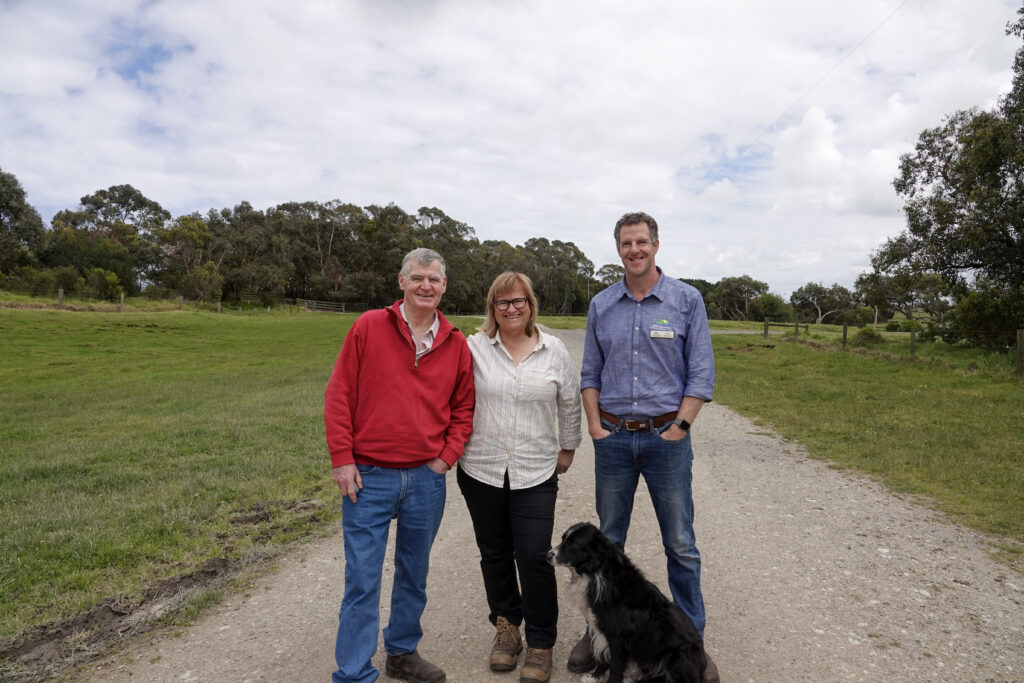
That’s what 35 South Gippsland farmers came to find out at the ‘Down to Earth Farm Field’ day at Malabar Farm in Tarwin Lower recently. The day was one of a series of workshops on the topic organised by West Gippsland Catchment Management Authority (the CMA) in partnership with Agriculture Victoria and Landcare.
The group was shown first hand by fellow farmers how it is possible to farm in a way that is in tune with the environment, creates healthier soils, helps reduce emissions and is financially successful.
“Carbon farming is a hot topic at the moment,” said Sam Shannon, Sustainable Agriculture Facilitator at the CMA. “There’s a lot of great information out there but sometimes having a chat with other local farmers facing similar challenges and conditions is the best way to learn. That’s what these farm field days are all about.”
Hosts Jenny and Paul O’Sullivan opened their farm gates to local beef, sheep, horticulture and hobby farmers from the region, including beef farmer Rob who has been farming for fifty-one years and is ‘keen to become carbon neutral’. Agriculture student Harper was just beginning his farming career and ‘came to learn’ while Jill from Fish Creek wanted to hear about improving soil health.
“There’s a thirst for knowledge about carbon storage and we know farmers like to learn from each other. This event is a way for us to share our philosophy of farming in tune with nature and talk about our experience of being involved in a pilot program to measure on-farm emissions,” said Jenny.
The audience heard about Jenny and Paul’s 34-year farming journey and their efforts to improve grazing management procedures, create healthier soils and reduce greenhouse gases on their 664-hectare beef and sheep property.
“Preserving and improving nature has always been our goal,’ said Paul. “And we’ve proven that you can have a financially successful business while also doing the right thing by the environment.”
Alison Kelly, Agriculture Victoria’s farm emissions specialist, then stepped through the process of calculating a farm’s greenhouse gas emissions using tools such as the Greenhouse Accounting Framework (GAF) calculator.
Alison Kelly, Agriculture Victoria’s farm emissions specialist, then stepped through the process of calculating a farm’s greenhouse gas emissions using tools such as the Greenhouse Accounting Framework (GAF) calculator.
Soil expert Peter Ronalds from Inspired Ag Solutions dug into the science of soil carbon explaining what it is, how it benefits productivity and the varying levels of carbon found in different soil types. He told the group that soil carbon tests help them to understand their carbon stocks and where to focus efforts to improve soil health.
“Every tonne of carbon stored in soil (or trees) can remove 3.67 tonnes of carbon dioxide from the atmosphere,” he said.
A farm tour brought the theory to life. The group visited conservation sites that Jenny and Paul have worked on over the years, including an area of remnant woodland where spectacular 300-year-old grass trees flourish thanks to fences that Jenny and Paul installed to keep cattle out.
“Understanding how to make the most of carbon farming depends on the type of farm, the business needs and the landscape it operates in. By showcasing local examples and providing practical advice, we can cut through the noise so farmers can get on with the job of sustainable farming,” concluded Sam.
For beef farmer Don, the reason for coming to the event was simple: “I love my bushland and want to protect it”.
The next farm field days focus on agroforestry, including how farmers can benefit from the Victorian Government’s ‘Trees on Farms’ program. Workshops are happening on Tuesday 17 February 2026 in Darriman and again on 24 February in Torwood. More information on the next Trees on Farms event is available here.
The Victorian Carbon Farming Outreach Program is delivered with funding support from the Commonwealth of Australia through the Department of Climate Change, Energy, the Environment and Water under the National Carbon Farming Outreach Program. The Program is delivered through a partnership between Agriculture Victoria, 10 Catchment Management Authorities and Landcare Victoria and other bodies.
With a focus on rivers and their catchments, the CMA works every day to improve catchment health through a range of programs and projects spanning from working towards self determination for Traditional Owners, partnering with legends like Landcare, Trust for Nature and Greening Australia and building relationships with the amazing landholders and community who are willing to work for river and catchment health.